
XRP Falls Back Into the Red After Explosive 50% Rally — Is the
Momentum Already Fading?
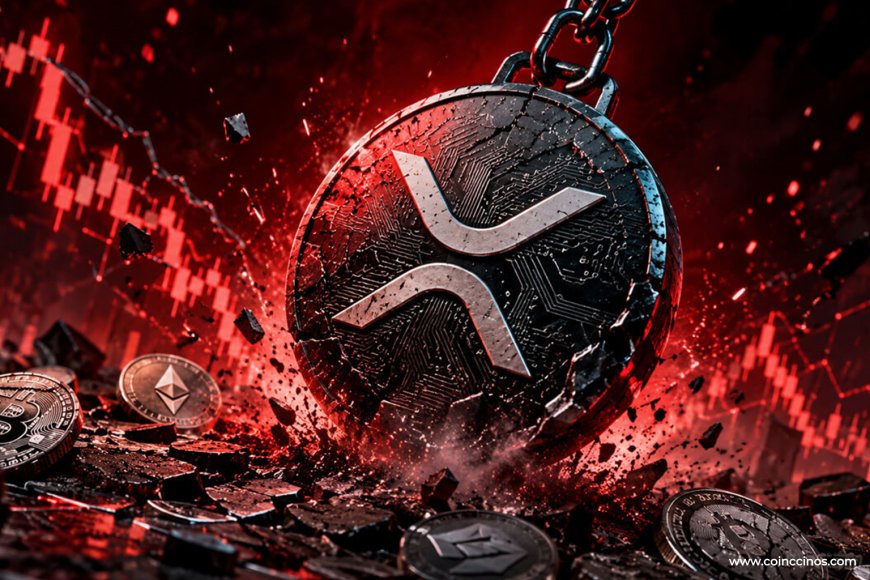
XRP has pulled back after one of its strongest weekly rallies in years, falling roughly 2.2% over 24 hours after gaining nearly 50% during the previous seven days. The reversal comes as traders question whether XRP's rally can continue while traditional financial institutions develop blockchain-based payment systems that do not require the XRP token.
XRP's sharp rally pushed the token dramatically higher from its August lows, but the latest weakness highlights an important question for investors: was the move the beginning of a sustainable recovery, or primarily a liquidity- and leverage-driven rally?
XRP's 50% Rally Meets Its First Major Test
XRP gained approximately 49.4% over seven days, according to the Cryptopolitan report, before slipping back into negative territory over the following 24 hours.
The rally was part of a broader crypto-market rebound, with Bitcoin and Ethereum also posting substantial gains.
XRP, however, significantly outperformed the largest cryptocurrencies, demonstrating how quickly capital can rotate into higher-beta altcoins when market sentiment improves.
Recent market data shows XRP briefly reaching around $1.70 before retreating toward the $1.45–$1.50 region.
That pullback is now testing whether the token can establish a higher support level.
Why Is XRP Falling After Such a Strong Rally?
There are several factors behind the reversal.
1. Profit Taking
After a gain of roughly 50% in one week, traders who bought near the lows have a strong incentive to lock in profits.
Rapid rallies frequently produce temporary corrections as early investors sell into strength.
2. Leverage
The speed of XRP's rise attracted derivatives traders.
When the market reversed, leveraged positions were liquidated, adding further selling pressure. Market reports indicate that roughly $500 million of XRP long positions were liquidated during a sharp weekend decline.
3. $1.70 Resistance
XRP encountered significant resistance around $1.65–$1.70.
A rejection from that region means buyers now need to demonstrate that they can defend the lower levels created during the breakout.
4. The Rally Was Partly Macro-Driven
The latest XRP surge did not occur in isolation.
The broader crypto rally followed the U.S. Treasury's announcement that it would increase long-term bond buybacks to at least $4 billion per operation, helping drive a decline in long-term yields and encouraging risk appetite.
That means XRP's performance may have been influenced as much by the broader liquidity environment as by XRP-specific developments.
The Bigger Challenge: Banks Are Building Their Own Blockchain Payment Systems
This is where the Cryptopolitan analysis becomes particularly interesting.
XRP's long-term investment narrative has historically been closely associated with cross-border payments and liquidity.
But major financial institutions are increasingly developing their own blockchain-based settlement infrastructure.
That creates a competitive question for the XRP ecosystem:
Do banks need a public cryptocurrency to achieve faster cross-border settlement?
Recent developments suggest that some institutions are attempting to solve the problem without one.
JPMorgan Is Building Blockchain-Based Deposit Infrastructure
JPMorgan has expanded its blockchain-based Kinexys infrastructure.
According to Cryptopolitan, the bank's Blockchain Deposit Accounts now support eight currencies, including:
- USD
- EUR
- GBP
- AUD
- HKD
- JPY
- RMB
- SGD
The system allows eligible customers to move balances around the clock and exchange supported currencies on-chain.
The significance is that a company could potentially hold dollars and receive yen through a bank-controlled blockchain environment without purchasing XRP or another cryptocurrency as a bridge asset.
That could challenge one of the core arguments behind XRP's institutional-payment thesis.
Citi Is Taking a Similar Approach
Citigroup is also developing blockchain-based financial infrastructure.
Its 24/7 USD Clearing network reportedly reaches more than 250 banks across more than 40 markets.
Citi's Token Services allow tokenized commercial-bank deposits to move through blockchain infrastructure.
The bank has also developed Real-Time Liquidity Sharing, designed to reduce the need for banks to pre-fund accounts in different markets.
That is important because pre-funded accounts are one of the problems that XRP-based payment infrastructure has historically aimed to address.
SWIFT Is Connecting Bank Tokens Without a Shared Cryptocurrency
Perhaps the most important development is coming from SWIFT.
On August 19, HSBC and Standard Chartered completed what was reported as the first cross-border transaction through SWIFT's blockchain ledger using tokenized bank deposits.
Rather than requiring a common cryptocurrency, each bank maintains its own tokenized deposits.
SWIFT acts as the coordination layer between the different systems.
This represents a fundamentally different model from XRP.
XRP model:
Public blockchain → XRP → cross-border settlement
Emerging bank-token model:
Bank A token → interoperability layer → Bank B token
The distinction could become increasingly important as banks develop regulated blockchain infrastructure.
But XRP Still Has an Important Advantage
The rise of bank-based blockchain systems does not automatically make XRP obsolete.
One major advantage of a public blockchain is that it can provide a neutral settlement layer between institutions that do not want to depend on one another's private infrastructure.
Banks may issue their own tokenized deposits, but those tokens remain liabilities of the issuing institutions.
XRP, by contrast, is a separate digital asset that does not represent a deposit claim on JPMorgan, Citi, HSBC or another bank.
That difference could matter in a truly global, multi-bank payment ecosystem.
XRP vs. Bank Tokenization
| Feature | XRP / XRP Ledger | Bank Token Systems |
|---|---|---|
| Settlement network | Public blockchain | Usually bank-controlled infrastructure |
| Native asset | XRP | Bank-issued deposit token |
| Central issuer | No single bank issuer | Individual banks |
| Cross-bank interoperability | Native public network | Requires interoperability layer |
| Regulatory environment | Crypto regulatory framework | Traditional banking framework |
| Liquidity model | Open-market digital asset | Bank/liquidity-provider based |
| Main challenge | Volatility & regulation | Interoperability & fragmentation |
The competition is therefore not necessarily XRP vs. blockchain.
It is increasingly:
Public crypto settlement vs. regulated institutional blockchain settlement.
XRP ETF Demand Remains a Positive Signal
Despite the correction, there are still signs of institutional interest.
U.S.-listed XRP spot ETFs reportedly attracted approximately $40 million in inflows during the latest week, their strongest weekly inflow period since May. Cumulative inflows have reached around $1.55 billion, according to data cited by FXStreet.
That is important because it suggests the recent rally was not entirely speculative retail trading.
Institutional products are still attracting capital.
However, ETF inflows alone do not guarantee that XRP will continue rising.
The Market Is Now Testing XRP's Real Strength
The most important phase of the rally may be the period after the 50% surge.
A strong market does not necessarily need to continue moving vertically.
Instead, investors will want to see:
Rally → consolidation → higher low → renewed buying
If XRP can stabilize above its previous breakout area, the recent surge could develop into a more durable recovery.
If the token rapidly loses the gains, however, the move could prove to have been primarily a short squeeze and liquidity event.
Bullish Scenario
XRP could regain upward momentum if:
- The token holds the $1.40–$1.50 area.
- ETF inflows remain positive.
- Bitcoin maintains its broader rally.
- Institutional demand continues increasing.
- XRP breaks decisively above $1.70.
- The CLARITY Act advances in September.
- Broader altcoin liquidity remains strong.
Recent market analysis identifies approximately $1.40–$1.50 as an important area to monitor, while a sustained break above $1.70 would strengthen the bullish case.
Bearish Scenario
The risks are equally significant.
Momentum Exhaustion
A 50% rally in one week can become difficult to sustain.
Leverage Flush
Further derivatives liquidations could accelerate a correction.
$1.70 Rejection
Failure to reclaim the recent high could encourage additional profit taking.
Weak Macro Conditions
If the broader crypto market reverses, XRP could experience amplified losses because of its higher beta.
Institutional Competition
If banks successfully deploy tokenized deposits at scale, the market may question how much XRP is actually needed for institutional cross-border payments.
The Next Big Catalyst: Regulation
The CLARITY Act remains an important potential catalyst for XRP and the wider U.S. crypto market.
The legislation could provide greater regulatory clarity around digital assets.
Market participants are currently watching the planned September 15 Senate cloture vote as a potentially important event.
If the legislation progresses, XRP could receive another boost from improved regulatory expectations.
If it stalls again, traders who bought the recent rally may become more cautious.
XRP Market Snapshot
| Indicator | Latest Signal |
|---|---|
| 7-day XRP move | ~+49.4% |
| 24-hour move in Cryptopolitan report | ~−2.2% |
| Recent resistance | ~$1.65–$1.70 |
| Key support zone | ~$1.40–$1.50 |
| Recent XRP ETF weekly inflows | ~$40M |
| Cumulative XRP ETF inflows | ~$1.55B |
| Major upcoming catalyst | CLARITY Act |
Figures reflect the cited reports and market data available around August 24–26, 2026.
Why This Matters Beyond XRP
The XRP story is part of a much larger transformation in global payments.
Banks no longer need to choose between:
Traditional banking
and
public blockchain networks
They can increasingly combine traditional financial assets with blockchain infrastructure.
Tokenized deposits, stablecoins, central-bank digital currencies and public cryptocurrencies may all compete or coexist.
The winner may ultimately be determined by:
Cost + speed + liquidity + regulation + interoperability + trust
Final Take
XRP's latest decline does not erase its nearly 50% weekly rally.
Instead, it marks the first serious test of whether that rally can develop into a sustainable recovery.
The token faces two very different forces.
On one side, ETF inflows, renewed crypto liquidity and regulatory optimism are supporting demand.
On the other, JPMorgan, Citi and SWIFT are developing blockchain-based payment infrastructure that can reduce the need for a shared cryptocurrency in some institutional transactions.
That makes the current XRP story bigger than a simple price rally.
XRP is now competing not only against other cryptocurrencies, but against the financial industry's rapidly evolving vision of tokenized money.
The immediate technical question is whether XRP can reclaim $1.70.
The bigger long-term question is even more important:
Can XRP remain a critical bridge asset as banks increasingly build their own on-chain payment networks?
That debate could shape XRP's next major market cycle.