
Anthropic's Claude Designs Three Working Gadgets,
but AI Hardware Reliability Remains Unproven
Anthropic's Claude AI model has demonstrated the ability to design electronic devices spanning circuit boards, mechanical enclosures and firmware, with human engineers successfully building three working prototypes from its designs.
The demonstration, developed in collaboration with electronics company Diode Computers, marks progress in applying AI to physical hardware engineering. However, an important question remains unanswered: how consistently can the model reproduce these results across repeated design attempts?
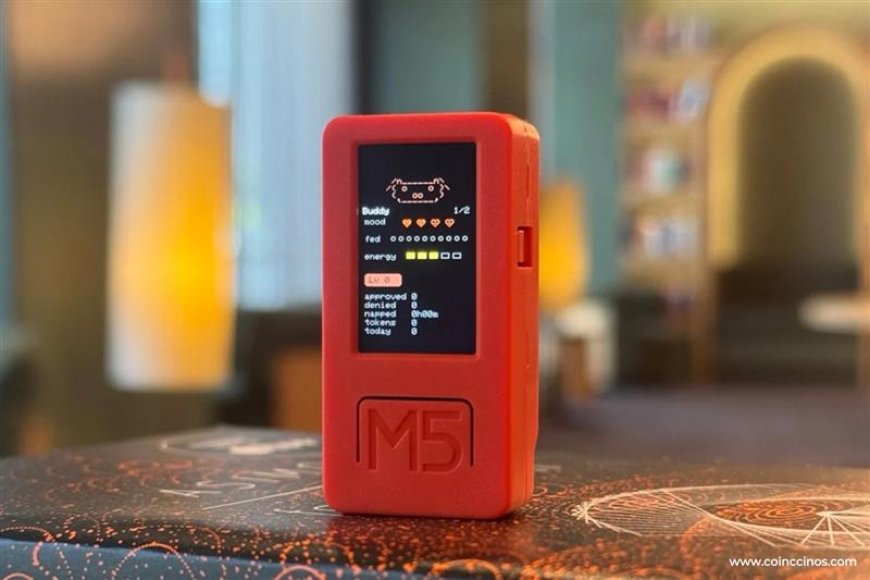
In a November 9 research report, Anthropic explained how its Claude Fable 5.2 model designed a USB speakerphone, a home voice-assistant hub and a handheld virtual pet. Diode engineers manufactured, assembled and tested the devices.
Key Highlights
-
Claude Fable 5.2 designed three electronic device prototypes with minimal prompting.
-
Its work covered circuit-board layouts, component placement, copper routing, CAD enclosures, firmware and parts lists.
-
Diode engineers built the prototypes, which reportedly worked without circuitry corrections.
-
Claude scored 69% on Diode's PCB Gym benchmark, compared with 25% for its earlier Fable 5 model.
-
Electrical validation, thermal testing, antenna tuning and commercial certification remain outstanding.
-
The demonstration does not establish an overall success rate across repeated hardware-design attempts.
1. Claude Moves Beyond Software Into Physical Hardware Design
Anthropic's experiment involved more than generating electronic diagrams. Claude was asked to coordinate several engineering disciplines needed to turn an idea into a functioning device.
For the USB-C speakerphone, it produced technical specifications, electrical schematics, a printed circuit board (PCB) layout, copper routing, a 3D-printable enclosure, firmware and a component list.
The model also designed the voice-assistant hub and handheld virtual pet using a similar process.
Anthropic reported that Diode manufactured all three circuit boards directly from Claude's design files without requiring manufacturing adjustments. The resulting prototypes reportedly worked without circuitry fixes.
This is significant because electronic hardware design requires components to work together physically and electrically, not simply look correct in a digital model.
2. Benchmark Results Show Improvement in Circuit-Board Design
Anthropic also disclosed performance results from two engineering benchmarks.
| Benchmark | Claude Fable 5.2 | Earlier model |
|---|---|---|
| Diode PCB Gym | 69% | Fable 5: 25% |
| BenchCAD 2.1 | 83.5% | Nearly double Fable 5.1 |
PCB Gym evaluates a model's ability to place components and route connections on circuit boards whose original layouts have been removed.
BenchCAD 2.1 tests whether models can reconstruct 3D components, assemblies and circuit boards using engineering drawings and rendered images.
The results indicate substantial progress in geometric reasoning and electronic design tasks. However, benchmark scores should not be interpreted as the probability that Claude can successfully manufacture a commercial device. They measure performance on specific evaluation tasks.
3. The Model Also Identified Real-World Design Problems
One particularly interesting example involved the speakerphone's enclosure.
Claude discovered that the circuit board could not be installed by lowering it directly into the case because the mute switch would collide with the enclosure wall.
It calculated that the board could be installed by tilting it approximately 25 degrees before moving it into position. The solution was tested in a 3D model and included in the assembly instructions.
For the voice-assistant hub, Claude also adjusted the enclosure design after identifying a microphone-port resonance problem. It shortened the ports through a wedge-shaped design to improve the acoustic configuration.
These examples demonstrate that the model considered downstream effects between electronic components, physical dimensions and device behaviour.
4. Why Consistency Is Still the Biggest Question
Despite the successful prototypes, the demonstration has important limitations.
First, Anthropic has not published an overall success rate showing how often Claude can independently produce usable hardware designs across repeated attempts.
Second, the three devices remain early prototypes. They have not completed electrical validation, antenna tuning, thermal testing or commercial certification. They were also not designed for mass production.
Third, Claude was not connected directly to the equipment needed to manufacture and physically test circuit boards. Diode engineers performed those tasks and provided occasional follow-up instructions.
Anthropic also disclosed a commercial relationship with Diode Computers, meaning the results come from a company-led collaboration rather than an independently conducted evaluation.
Consequently, the demonstration establishes promising engineering capabilities, but it does not yet prove that AI can independently replace professional hardware-development teams.
What Happens Next?
Anthropic says it plans to investigate whether Claude can design more complex, denser and faster circuit boards, validate its work through simulation and learn from physical measurements taken from completed devices.
If these capabilities improve, AI-assisted hardware engineering could help companies explore prototypes more quickly, reduce design iterations and support engineers during complex development projects.
The next important milestone will be demonstrating repeatable results across a broader range of devices and rigorous physical testing conditions.
Final Takeaway
Claude's three working hardware prototypes show that AI is progressing beyond software generation into practical engineering workflows.
Its ability to coordinate circuit-board design, mechanical modelling and firmware is an important development. However, reliability across repeated attempts, independent testing and commercial certification remain unresolved.
For now, AI appears increasingly capable of assisting hardware engineers, but the evidence does not yet support treating it as a fully autonomous replacement for them.
Disclaimer: This article is for informational and educational purposes only and does not constitute financial or investment advice. Coinccino does not provide buy or sell signals.